

The 2026-27 football season will introduce several new laws aimed at reducing time-wasting, limiting deliberate stoppages and increasing the amount of time the ball is in play.
The changes, which were introduced at the 2026 FIFA World Cup, will apply across English football, including the Premier League, EFL and Community Shield. VAR-related changes will apply only to competitions that use the technology.
The new Premier League rules include five-second countdowns for delayed goal-kicks and throw-ins, stricter time limits for substitutions and injured players leaving the pitch, new measures targeting goalkeeper tactical timeouts and changes to how certain goal-kick handball situations are handled.
The changes are intended primarily to alter player behaviour rather than punish teams unnecessarily.
Five-second countdowns for goal-kicks and throw-ins
Referees will have new powers to deal with players who deliberately delay restarts.
The countdown will not automatically begin when the ball goes out of play. Instead, the referee will determine whether a player is deliberately disrupting the restart.
Tactics such as leaving the ball on a cone or dropping it for a team-mate can trigger the countdown.
The referee will blow the whistle to warn the player and signal the start of the five seconds while visibly counting with an arm movement.
If the player fails to restart play before the countdown expires, the referee will blow the whistle again and award the throw-in to the opposition.
ALSO READ: FULL LIST: Tallest players in Premier League history
The rule does not apply to the preparation of long throws, which are regarded as set-piece routines. However, the countdown can begin once players are ready for the restart.
Goalkeepers who deliberately take too long over a goal-kick can also be punished. Instead of simply awarding an indirect free-kick, the referee can award a corner to the opposition.
Substitutions now have a time limit
Players being substituted will have 10 seconds to leave the pitch at the nearest point.
If they fail to do so, the incoming substitute must wait for at least one minute before entering, leaving the team with 10 players during that period.
Middlesbrough’s Will Lankshear became the first player to be punished under the new rule during the Carabao Cup tie against Wrexham.
Lankshear, who had scored to put Middlesbrough 1-0 ahead in the 80th minute, took too long to leave the pitch while acknowledging supporters.
Middlesbrough manager Kim Hellberg urged him to hurry, but substitute Fin Cartwright was not allowed to enter immediately.
“I didn’t know!” the former Tottenham player said after the game.
There are exemptions, including situations involving injuries or security concerns about where a player can leave the field.
Injured players must spend one minute off the pitch
The time an injured player must spend off the pitch after receiving treatment has increased from 30 seconds to one minute.
The rule is also designed to prevent players from deliberately stopping play to disrupt an opponent’s momentum.
A player must leave the field if the referee stops play because of an injury, even if the player did not request treatment.
The rule does not apply when the ball naturally goes out of play while the player is down, such as for a throw-in or goal-kick.
There are also exemptions. For example, an injured player may not have to spend the additional minute off the field in certain situations when the opponent responsible for the foul receives a yellow or red card.
Goalkeeper tactical timeouts targeted
The new season will also see a trial aimed at stopping the use of what has become known as the “goalkeeper tactical timeout”.
The tactic involves a goalkeeper going down and requesting treatment, allowing the manager to use the stoppage to give instructions to the rest of the team or disrupt the opposition’s momentum.
Under the new Premier League rules, if a goalkeeper requests treatment, an outfield player chosen by the coach must leave the pitch for one minute.
The team has 10 seconds to inform the fourth official which player will leave. If no player is nominated within that period, the captain must make the decision.
There are exemptions, including situations where the goalkeeper has been fouled or is bleeding.
New approach to goal-kick handballs
The new Premier League rules will also provide a more consistent approach when defenders handle the ball after a short goal-kick.
A goal-kick will be considered to have been taken once the goalkeeper or a defender kicks the ball.
If a defender then deliberately handles the ball inside the penalty area, a penalty can be awarded.
If the goalkeeper handles the ball after a defender has kicked it to them, the incident can result in an indirect free-kick for a backpass.
The change follows several incidents in which there had been uncertainty over when a goal-kick was considered to have been completed.
VAR gets new areas of intervention
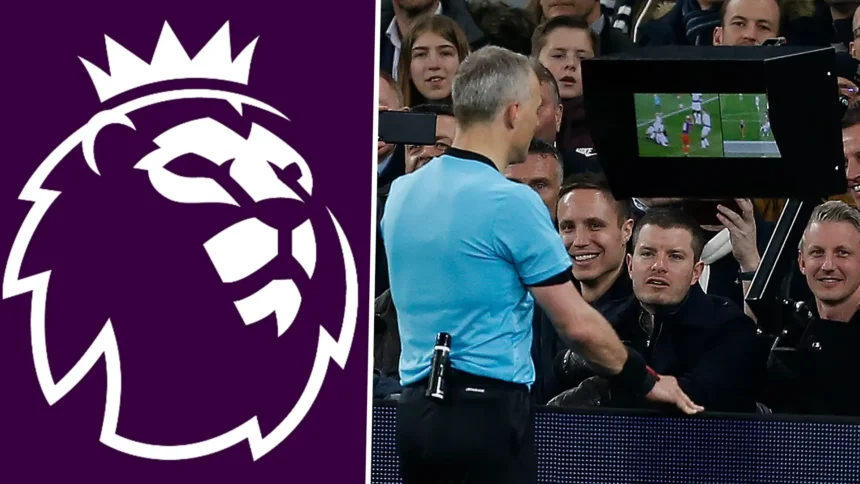
There will also be some changes to the situations VAR can review.
One change concerns players sent off after receiving two yellow cards. VAR will be able to review the second caution when it results in a red card.
However, VAR will not review a potential second yellow card while a player remains on the pitch.
The review must involve a clear error rather than simply a different interpretation of a challenge.
There will also be a trial allowing VAR to intervene when an attacking foul occurs before a set-piece and directly leads to a goal, penalty or disciplinary action.
Because the ball is not in play when the foul occurs, the restart will be a retake of the corner rather than a free-kick.
Defensive fouls committed before the ball is in play will not be subject to the same VAR review because a penalty cannot be awarded for an incident occurring before the restart.
Mistaken identity rule clarified
VAR will also continue to intervene in cases of mistaken identity.
The rule is intended for situations where the referee penalises the wrong team or player, rather than for subjective disagreements over a decision.
The International Football Association Board (IFAB) has also clarified that the rule should not be interpreted as giving VAR a general power to review simulation.
What VAR will not review
Despite the expansion of VAR’s remit in some areas, its powers will remain more limited in English football than at the 2026 World Cup.
There will be no VAR interventions for incorrect corner decisions.
VAR will also not intervene over red cards issued for players covering their mouths during confrontational incidents.
The changes are part of a broader effort to reduce delays and increase effective playing time.
At the 2022 World Cup in Qatar, the ball was in play for an average of 58 minutes and three seconds, representing 56.86% of total match time.
At the 2026 World Cup, the average increased slightly to 58 minutes and 16 seconds, but with less added time, meaning the ball was in play for 60.43% of the match.
The new rules are therefore aimed at ensuring more of each match is spent with the ball in play, while reducing opportunities for deliberate delays and tactical stoppages.