

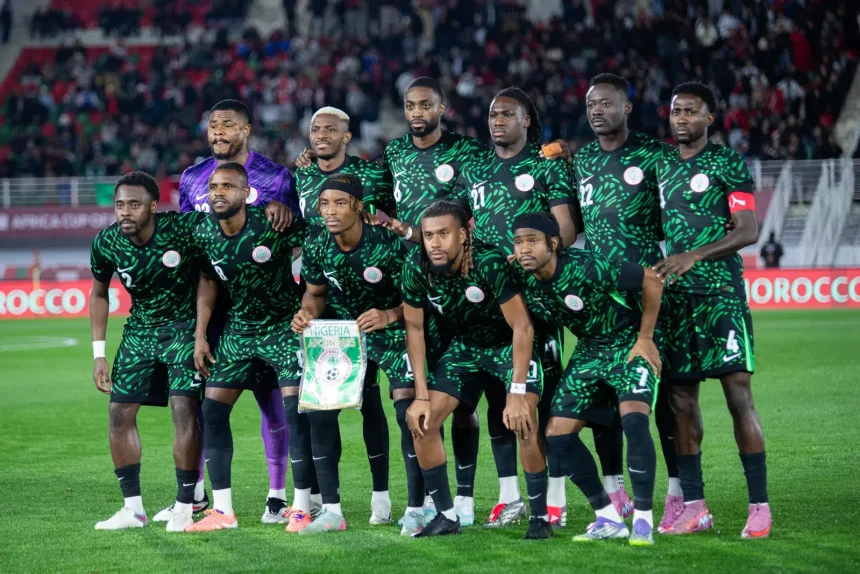
Nigeria’s Super Eagles AFCON 2027 qualification hopes are still alive, but the margin for error has almost disappeared.
A 3-0 defeat to Guinea-Bissau in Bissau on 29 September left Eric Chelle’s side with three points from two Group L matches, behind Guinea-Bissau on six. Because Tanzania are already qualified as co-hosts, only one team from Nigeria, Guinea-Bissau and Madagascar will reach the finals.
Group L standings after two matchdays
Guinea-Bissau lead Group L with six points from two matches, having beaten Tanzania 2-0 away and Nigeria 3-0 at home. Nigeria sit second on three points after their 2-1 comeback win over Madagascar in Uyo on 25 September.
Madagascar and Tanzania both have one point following their 1-1 draw in Meknes, Morocco. Tanzania’s position in the table does not matter for qualification because their place at AFCON 2027 is already secured as co-hosts.
The current table, for reference: Guinea-Bissau 6 points, Nigeria 3, Madagascar 1, Tanzania 1. But Tanzania’s points do not count in the race for the single available spot.
Why only one team can qualify from Group L
CAF’s qualifying format for AFCON 2027 placed 48 nations into 12 groups of four, and in nine of those groups, the top two teams qualify directly. Groups D, H and L are different because they contain the co-hosts: Kenya, Uganda and Tanzania respectively. In those three groups, only the highest-placed team outside the host nation will qualify.
That means Nigeria, Guinea-Bissau and Madagascar are competing for one ticket.
ALSO READ: AFCON 2027: ‘We’ll be looking for calculators’, Adepoju warns Super Eagles
Tanzania’s results still count on the table, but Tanzania cannot take the qualifying spot, and every point Nigeria drops against Tanzania in November still damages their own tally while doing nothing to help Tanzania’s already-guaranteed status.
This is the rule that has turned what looked like a favourable draw into a tight three-way race. Austin Eguavoen, the NFF technical director, said after the draw that Madagascar were “another hard nut to crack” and warned against assuming Nigeria’s pedigree would be enough.
Nigeria’s remaining fixtures and points they need
Nigeria have four matches left, and the first two come in the November international window against Tanzania, with Nigeria hosting the first leg on 11 November 2026 and travelling to Tanzania for the return on 15 November. The venue for the home fixture could be the renovated Teslim Balogun Stadium in Lagos, though Uyo remains an option, as the NFF has not confirmed the venue.
The final two matches are scheduled for the March 2027 window, as Nigeria will travel to Madagascar before hosting Guinea-Bissau. CAF has set the final two rounds for 22 to 30 March 2027.
Winning all four matches would take Nigeria to 15 points, and that would put them in the strongest possible position. But 15 points is not an automatic guarantee because Guinea-Bissau could also reach 15 if they win their other matches and lose to Nigeria in the final matchday.
In that scenario, the head-to-head record would decide who qualifies.
The head-to-head problem with Guinea-Bissau
The tiebreakers used by CAF give more importance to head-to-head results than to the overall goal difference; if two teams have the same number of points, the first criterion is the number of points they have earned in their matches against each other, followed by the goal difference in those direct encounters.
Guinea-Bissau won the first meeting 3-0. If both teams finish level on points, Nigeria must beat Guinea-Bissau in the return fixture by at least three goals to level the head-to-head goal difference, and by four goals to win it outright.
A 3-0 win for Nigeria would leave the head-to-head goal difference level, pushing the tiebreaker to goals scored in those matches, then to overall goal difference.
That is a tall order against a side that has already taken maximum points from two matches. Nigeria’s 3-0 defeat also damaged their overall goal difference, which could matter if the tiebreaker moves past head-to-head.
What Guinea-Bissau and Madagascar must do?
Guinea-Bissau’s remaining fixtures include two matches against Madagascar, a home match against Tanzania, and a trip to Nigeria. If Guinea-Bissau win both matches against Madagascar, they will arrive in Nigeria for the final matchday with a strong points total and the head-to-head advantage already secured.
Madagascar are not out of it. They have one point from two matches and still have to play Guinea-Bissau and Nigeria. Two wins against Guinea-Bissau would put them back in the race. Their 1-1 draw with Tanzania showed they can take points from teams that are not fighting for qualification.
The scenario that most concerns Nigeria is Guinea-Bissau matching Nigeria’s results through the November window. If both teams win their next two matches, Nigeria will go into March on nine points, Guinea-Bissau on 12.
Nigeria would then need to beat Madagascar away and beat Guinea-Bissau by at least three goals, while hoping Guinea-Bissau drop points elsewhere. OneFootball described that as a “winner-take-all” final matchday where Nigeria “could find themselves needing to win by at least three goals”.
A realistic look at Nigeria’s chances
Nigeria remain in control of their own qualification in one sense: if they win all four matches, they give themselves the best possible chance. But the 3-0 defeat in Bissau handed Guinea-Bissau a head-to-head cushion that Nigeria cannot fully erase without a large win in March.
The November double-header against Tanzania is the immediate priority. Six points from those two matches would take Nigeria to nine and keep them within striking distance of Guinea-Bissau.
Dropping points against a team that has already qualified would leave Nigeria relying on Madagascar to take points off Guinea-Bissau, and on a heavy win in the final matchday.
Victor Osimhen was absent from the first two qualifiers due to a muscle injury, and it is still uncertain whether he will be available in November.
Although his return would strengthen the attack, the more serious issue is a defence that had allowed three goals in Bissau and a midfield that had great difficulty in controlling the game.
Can Nigeria still qualify for AFCON 2027?
Yes, but only by finishing above Guinea-Bissau and Madagascar in Group L. Nigeria have four matches left and can reach 15 points if they win all of them. They need Guinea-Bissau to drop points, and they need a large win in the return fixture to overcome the head-to-head deficit.