

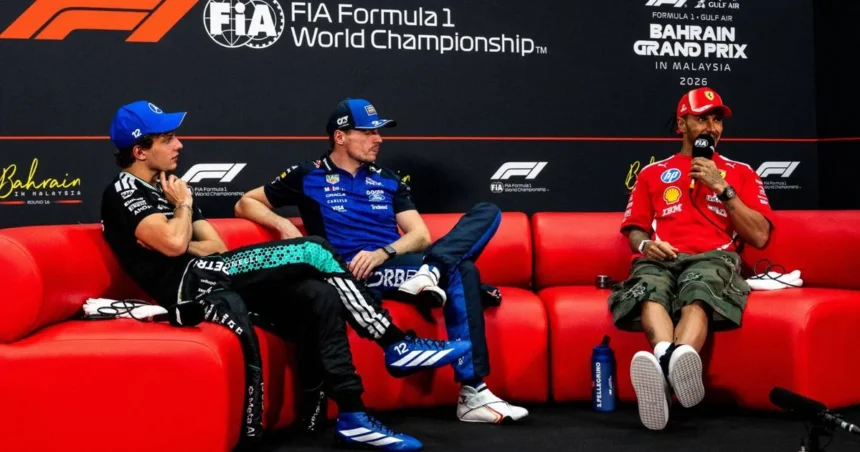
Max Verstappen and Lewis Hamilton have likened the software glitch that affected several cars before the Bahrain Grand Prix to a “Lego race”.
The problem left multiple cars struggling to move in wet conditions during the formation laps after a tropical downpour delayed the start of the race by almost an hour.
Verstappen and Hamilton, who started from the front row, were among those affected by the issue.
The glitch was traced to software governing how the cars’ electrical power could be deployed in wet conditions. It was triggered by a combination of low engine speeds, limited grip and specific characteristics of the circuit.
Verstappen, who went on to claim his first victory of the season, said he initially thought other drivers were waiting for him when he noticed cars struggling behind him.
“These engines are so complicated and a lot of software is implemented,” Verstappen said.
“I triggered [the problem] first and then I looked in my mirror, I was like, ‘Wait, are they waiting for me or what’s going [on]…?’ It was like the Lego race.”
Verstappen was referring to a show run involving battery-powered Lego F1 cars held before the British Grand Prix in July.
Hamilton, who finished third, said he also had to stop his car and restart the engine.
ALSO READ: F1: Verstappen wins chaotic Bahrain GP
“Yeah, we had the same speed. I had to stop on track and stop the car and engine and restart it. I’ve never done that before,” Hamilton said.
Verstappen added: “It was insane. Like, it’s the Lego power. At some point we were five-wide on the straight because we couldn’t understand what was going on.
“Then we did a lap and then I see eight other cars crawling still, and I saw you (Hamilton) by yourself crawling. That’s not what you want, right, for the sport.”
Mercedes driver George Russell, who retired from the race with an engine failure, said the incident “didn’t feel very F1”.
FIA to investigate glitch
FIA single-seater director, Nikolas Tombazis, said the governing body would carry out a full investigation into the problem.
Tombazis said the software had been tested but not under the specific conditions encountered in Malaysia, partly because there had been little wet-weather running this season.
“Cars are complicated. We would all like it to be simpler, but when you have electrical energy and combustion energy all working together, and obviously when you want to ensure that there’s sporting fairness between the teams, that is complicated,” Tombazis said.
He added that the FIA would review what happened and work to prevent a repeat.
“Obviously, that was a major criticality, and we need to make sure we avoid it,” Tombazis said.
“Can I guarantee it will never happen again? This specific problem, yes. A problem, no, but we will do our best to avoid it, of course.”
The incident is the latest problem linked to the complexity of Formula 1’s new hybrid power units, which have an almost 50-50 split between internal combustion and electrical power.
The power units have required increasingly complex energy-management systems, with drivers complaining throughout the season about how the cars behave when electrical and combustion power cannot be deployed at their full combined output.
The regulations will be adjusted next season, including changes to the energy split, in an attempt to address some of those concerns.
McLaren team principal, Andrea Stella, said the incident was not ideal for the sport but urged patience with the new regulations.
“What happened at the start obviously is not ideal in terms of presentation of the sport,” Stella said.
“But at the same time it is the first year of new regulations, quite complex from a regulatory point of view, and it was also the first time we started in such conditions.”
Grid order also affected
The software problem also created uncertainty over the order of the cars if the race had needed to restart.
The field became jumbled during the formation laps, raising questions about whether the regulations required the grid order to be changed.
While FIA software engineers worked to resolve the problem, officials decided to restore the original starting order because the situation was unprecedented and outside the control of the teams.
Mercedes deputy team principal, Bradley Lord, said changing the order would have created further confusion for fans.
“If you think of the millions of people watching around the world, they tune in for the start and suddenly the cars are all in a jumbled up order because of something that happened 40 minutes earlier and it was behind a safety car on a formation lap,” Lord said.
“That would have been a much harder thing to explain than resetting and then going from where we did.”