
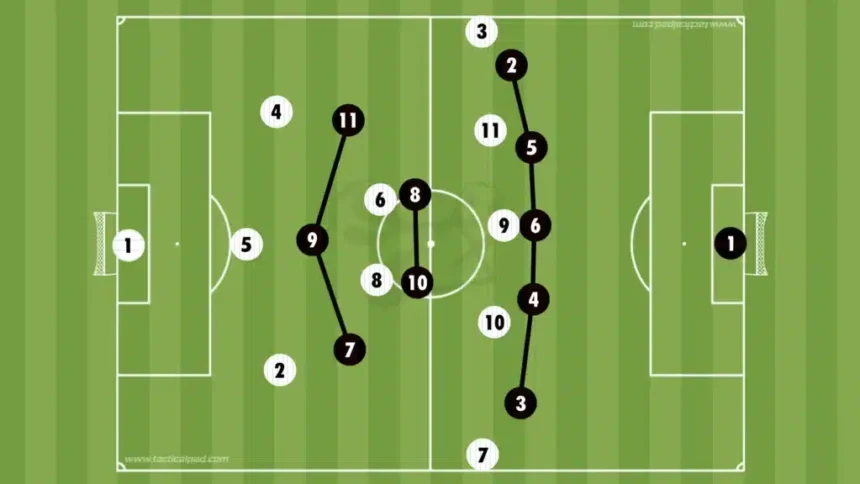
Football matches are often decided by small margins, with tactical decisions capable of influencing the outcome as much as individual errors.
A misplaced pass, poorly timed tackle or defensive mistake can change a game, but tactical errors such as pressing without adequate cover, defending too deeply or making an unsuitable substitution can also leave a team vulnerable.
As modern football becomes increasingly tactical, coaches analyse opposition structures, pressing patterns, defensive transitions and set pieces before matches. However, even well-prepared teams can make tactical mistakes.
Sporting Tribune outlines five tactical mistakes football teams must avoid.
Pressing without defensive cover
Pressing can be an effective way to win possession high up the pitch, but it becomes risky when the players behind the first wave fail to provide adequate cover.
If a midfielder moves forward to press while the centre-backs and other midfielders fail to maintain their defensive structure, opponents can play through the pressure and attack the space left behind.
ALSO READ: 10 players who made iconic returns to their former clubs
One successful pass can expose a large area of the pitch, particularly against teams with quick forwards capable of exploiting space behind the defensive line.
Defending too deep after taking the lead
Dropping deeper after taking the lead can help a team protect its advantage, but retreating too far may invite unnecessary pressure.
When the defensive and midfield lines move close to the penalty area, the opposition gains more possession and territory, increasing the pressure on the defending team.
A low block can be effective when properly organised, but problems arise when a team abandons its attacking threat completely and allows the opposition to dictate play.
Leaving too much space between the lines
Defensive compactness is crucial to preventing opponents from exploiting spaces between the defence and midfield.
A team becomes vulnerable when its midfield pushes forward while the defence remains deep, creating gaps where attacking players can receive the ball with time and space.
An attacking midfielder who receives possession facing forward can shoot, dribble, play a through-ball or combine with a striker.
Teams must therefore maintain manageable distances between their defensive and midfield units.
Overcommitting players in attack
Attacking with numbers is important when trying to score, but committing too many players forward can leave a team exposed when possession is lost.
This is where rest defence becomes important. It refers to the players and defensive structure a team maintains behind the ball while attacking.
If too many players are committed forward, a misplaced pass or lost duel can expose the defence to a counter-attack.
The risk is particularly high against teams with fast forwards capable of exploiting open spaces.
Making the wrong substitution
Substitutions can change the course of a match, but an unsuitable change can also disrupt a team’s structure.
For example, a manager protecting a narrow lead may replace a midfielder who provides defensive balance with an additional attacking player.
While the change may increase the team’s attacking threat, it could also leave the side vulnerable in midfield and reduce its ability to control possession.
Similarly, introducing a player whose strengths do not suit the demands of the match can create new weaknesses.
Managers must therefore consider not only the quality of a substitute but also how the player’s profile fits the tactical demands of the game.