

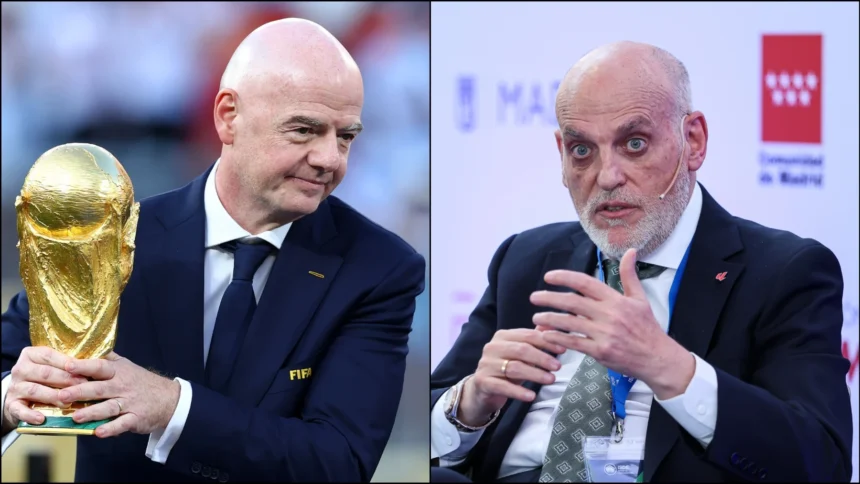
La Liga president, Javier Tebas, has called on FIFA president Gianni Infantino to resign, accusing football’s world governing body of damaging the sport through decisions made during the 2026 FIFA World Cup.
Speaking in an interview with Italian newspaper La Gazzetta dello Sport, Tebas said Infantino’s leadership was harming domestic football and criticised several aspects of the tournament, including mandatory hydration breaks, the extended half-time show during the final, the handling of Folarin Balogun’s suspension, and proposals to expand future World Cups to 64 teams.
“In my opinion, yes, I think his time is up,” Tebas said when asked whether Infantino should resign.
‘Football industry is being destroyed’
Tebas argued that FIFA has become too focused on expanding the World Cup at the expense of domestic leagues, which he described as the foundation of the global football economy.
“It’s the national competitions that sustain this sport,” he said.
“They are destroying the football industry, which generates tens of thousands of jobs, for an event that lasts 40 days and involves a minority of players.”
He also criticised discussions about increasing the men’s World Cup to 64 teams, saying the move would place even greater strain on the football calendar.
“Not everything can revolve around the World Cup,” Tebas added.
“We need fewer international matches and more protection for national football, at all levels. They don’t realise they are making irresponsible decisions.”
Questions over FIFA’s governance
Although he believes Infantino should leave office, Tebas said the FIFA president continues to enjoy the backing of national football associations.
“He shouldn’t stay, but the current state of affairs means he won’t leave,” Tebas said.
He claimed FIFA’s electoral system discourages challengers from contesting the presidency.
“There’s no opposition candidate, nobody wants to stand just to lose,” he said, describing the election process as “rotten at its core.”
Infantino, 56, is widely expected to seek re-election for a fourth term during FIFA’s Congress scheduled for March.
Balogun suspension controversy
Tebas also criticised FIFA’s handling of the suspension involving United States forward, Folarin Balogun, during the tournament.
Balogun avoided serving a suspension for the United States’ Round of 16 match against Belgium after an intervention by US President Donald Trump, a decision that drew criticism from several football authorities.
“The suspension of the American player’s ban was absolutely serious,” Tebas said.
“They were lucky that Belgium eliminated the USA, because otherwise a case could have arisen that might have cost Infantino his job.”
“Since Belgium won, they managed to bury the matter. But these things are just the tip of the iceberg.”
ALSO READ: ‘You crossed a red line’, UEFA slams FIFA over Balogun ruling
UEFA had earlier described the decision as “unprecedented, incomprehensible and unjustifiable,” while UEFA president Aleksander Ceferin did not attend the World Cup final, with the controversy cited as one of the reasons.
Criticism of hydration breaks and half-time show
Tebas questioned FIFA’s introduction of mandatory three-minute hydration breaks during matches in the United States, Canada and Mexico, arguing they were unnecessary in some venues.
FIFA introduced the breaks as part of its player welfare measures during the expanded tournament.
However, Tebas claimed the stoppages mainly served commercial interests.
“Hydration breaks are a lie. We have them in La Liga, but only when it’s genuinely hot,” he said.
“Here, the pitches in Dallas, Los Angeles, Atlanta had air conditioning; I had to put on a jumper in the stands. It was a lie, a break for advertising.”
He also criticised FIFA’s decision to extend half-time during the World Cup final to more than 27 minutes to accommodate a high-profile entertainment show featuring artists including Madonna, BTS, Shakira and Justin Bieber.
“So, if they need a 27-minute half-time break, they’ll have it,” Tebas said.
“It’s proof that we are governed by an institution that does and decides what it wants, when it wants, following only its own interests without considering the rest of football. And in many cases, it acts to the detriment of football.”