

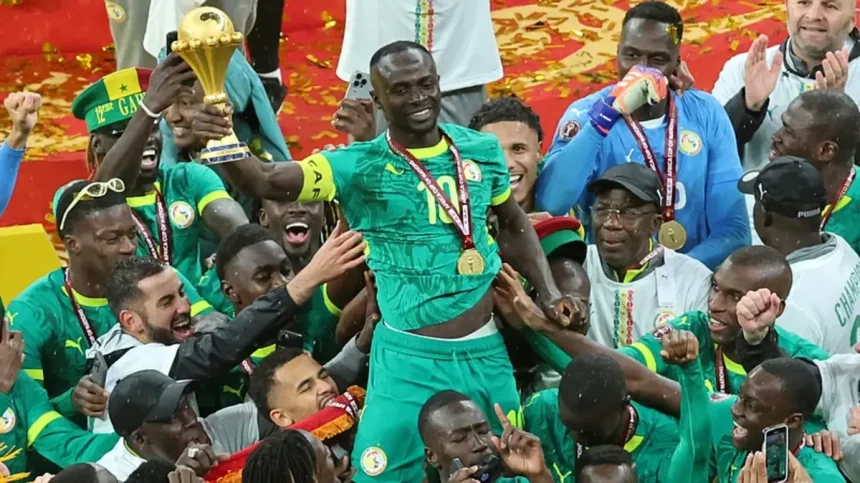
Morocco and Senegal are awaiting a ruling from the Court of Arbitration for Sport (CAS) over the controversial final of the 2025 Africa Cup of Nations (AFCON), with the outcome expected on Tuesday.
The case centres on Senegal’s appeal against a decision by the Confederation of African Football (CAF) to strip the country of the title and award Morocco a 3-0 victory after ruling that Senegal had forfeited the final.
The appeal was heard in private on October 8 by a three-member panel of arbitrators appointed by CAS.
Senegal had initially won the final 1-0 after extra time in January, with Pape Gueye scoring the decisive goal against hosts Morocco at the Prince Moulay Abdellah Stadium in Rabat.
However, the match was overshadowed by controversy late in regulation time when referee Jean Jacques Ndala awarded Morocco a penalty following a VAR review.
Senegal players and officials protested the decision, with coach Pape Thiaw leading some of his players and staff off the pitch. Supporters also clashed with security personnel as tensions escalated in the stadium.
Play eventually resumed, but Morocco missed the opportunity to take the lead when Brahim Diaz failed to convert the penalty in the 124th minute, attempting a Panenka-style chip that was saved by goalkeeper Edouard Mendy.
Gueye scored in extra time to give Senegal victory and what appeared to be their second Afcon title.
How Morocco were awarded the title
The Royal Moroccan Football Federation (FRMF) subsequently lodged a complaint with CAF, arguing that Senegal had breached the competition regulations by leaving the pitch before the end of the match without the referee’s permission.
The federation relied on Article 82 of the Afcon regulations, which states that a team that refuses to play or leaves the field before the end of a match without the referee’s authorisation can be considered to have forfeited the game.
In March, CAF’s appeals board upheld Morocco’s complaint and ruled that Senegal had forfeited the final, awarding the hosts a 3-0 victory.
Senegal’s Football Federation (FSF) rejected the decision, describing it as “unfair, unprecedented and unacceptable”, before taking the case to CAS.
The ruling attracted criticism, with questions raised over whether CAF’s appeals board had the authority to overturn the result of a match that had been completed.
What is at stake?
CAS, based in Lausanne, Switzerland, is an independent body established to resolve disputes in sport. Its decisions are generally final and binding, although they can be challenged before Switzerland’s highest court on limited legal grounds.
The three-member panel handling Senegal’s appeal is led by French sports law expert Gerald Simon. Italian international law professor Luigi Fumagalli and Hamburg-based lawyer and University of Zurich professor Ulrich Haas are the other members.
ALSO READ: CAS fixes hearing date for Senegal’s 2025 AFCON title appeal
A decision in Senegal’s favour could overturn CAF’s ruling and restore the title to the country, while a dismissal of the appeal would leave Morocco as the official champions.
CAF president Patrice Motsepe said in March that the organisation would respect whatever decision CAS reaches.
Fallout from the final
The dispute has strained relations between the two football federations and generated wider debate about the administration of African football.
Senegal’s walk-off during the final also prompted a change to the Laws of the Game. In April, the International Football Association Board (IFAB), which oversees football’s rules, announced that players who leave the pitch in protest against a referee’s decision could be sent off.
The rule also applies to team officials who encourage players to leave the field. Teams responsible for causing a match to be abandoned can, in principle, forfeit the game.
The final was also marred by incidents involving supporters and stadium officials. Senegalese fans clashed with security personnel, while allegations were made about laser pens being directed at players and ball boys interfering with goalkeeper Edouard Mendy’s towel.
The controversy has continued to affect the relationship between the two countries’ football authorities, with both sides maintaining their positions over the events of the final.