

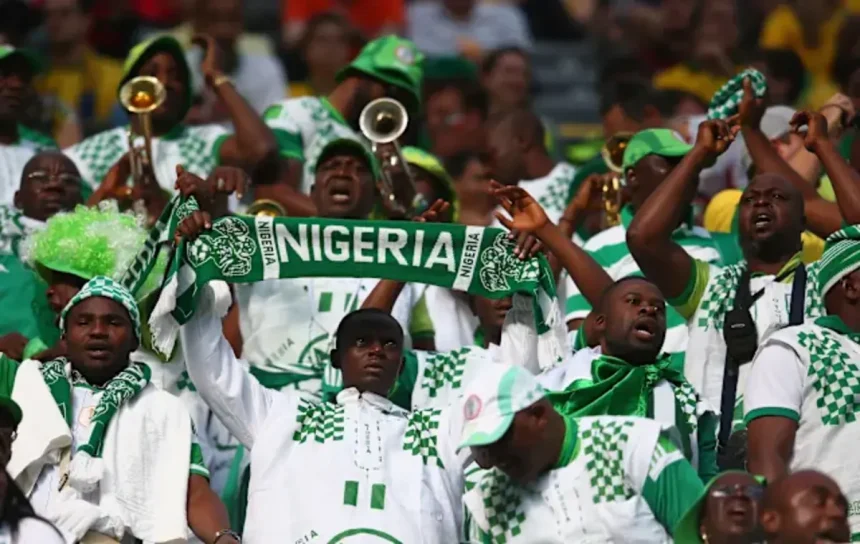
Nigeria’s sporting story is not defined only by the trophies that slipped away or the major tournaments the country failed to reach.
For 66 years, Nigerian athletes and teams have also produced moments that have brought the country international recognition, broken records and created memories that have endured across generations.
Football has provided some of the biggest celebrations, from the Super Eagles’ Africa Cup of Nations (AFCON) triumphs to the Dream Team’s Olympic gold, but the country’s sporting achievements stretch far beyond the pitch.
From Atlanta to Oregon, from the Paralympic Games to the Commonwealth stage, Nigerian athletes have repeatedly shown that the country’s sporting talent extends across several disciplines.
Here are six moments that stand out.
Atlanta 1996: The Dream Team and Ajunwa
The 1996 Olympic Games in Atlanta remain one of the defining moments in Nigerian sports history.
The country’s football team won gold in the men’s tournament after one of the most memorable runs in Olympic football.
The Dream Team came from behind to defeat Brazil 4-3 in the semi-final after extra time before overcoming Argentina 3-2 in the final.
The victory made Nigeria the first African country to win Olympic gold in men’s football.
The team featured several players who would go on to become major figures in Nigerian football, including Nwankwo Kanu, Jay-Jay Okocha, Daniel Amokachi, Sunday Oliseh, Victor Ikpeba and Emmanuel Amunike.
Atlanta also produced another historic moment for Nigeria.
ALSO READ: How Nigeria’s Flamingos captured WAFU B title
Chioma Ajunwa won gold in the women’s long jump, becoming the first Nigerian to win an individual Olympic gold medal.
Her leap of 7.12m secured the title and added another landmark to an unforgettable Games for Nigeria.
The two achievements made Atlanta 1996 much more than a football story.
Super Eagles’ AFCON triumphs
Nigeria’s history at the Africa Cup of Nations is one of the most successful on the continent.
The Super Eagles have won the tournament three times, in 1980, 1994 and 2013. CAF records the three victories as Nigeria’s AFCON titles.
The first came in 1980, when Nigeria hosted the tournament and defeated Algeria 3-0 in the final in Lagos.
Fourteen years later, the Eagles claimed their second title in Tunisia, beating Zambia 2-1 in the final.
The third triumph came in South Africa in 2013.
Nigeria defeated Burkina Faso 1-0 in the final through Sunday Mba’s goal, ending a 19-year wait for another AFCON title.
The 2013 victory also created a special place in the history of Stephen Keshi, who became only the second person after Egypt’s Mahmoud El-Gohary to win the competition as both a player and a coach.
Nigeria have also accumulated numerous other AFCON medals. By the start of the 2025 tournament, CAF listed the country with three titles, five runners-up finishes and eight bronze medals.
The Super Falcons’ continental dominance
If the Super Eagles have established Nigeria as one of Africa’s leading men’s football nations, the Super Falcons have gone even further in the women’s game.
Nigeria have won the Women’s Africa Cup of Nations a record 10 times.
The dominance began with the inaugural tournament in 1991 and continued through successive generations of Nigerian women’s footballers.
The Falcons have produced stars such as Florence Omagbemi, Mercy Akide, Perpetua Nkwocha, Rita Chikwelu, Asisat Oshoala and several others who have helped maintain Nigeria’s position at the top of African women’s football.
Their 2024 WAFCON triumph, played in Morocco in 2025, provided another memorable chapter.
Nigeria came from two goals down to defeat hosts Morocco 3-2 in the final and extend their record number of continental titles to 10.
The achievement underlined a remarkable consistency that has survived changes in players, coaches and generations.
Tobi Amusan breaks through
For years, Nigerian athletics produced Olympic and Commonwealth medallists, but Tobi Amusan created a moment that moved the country to the very top of world athletics.
At the 2022 World Athletics Championships in Eugene, Oregon, Amusan ran 12.12 seconds in the semi-final of the women’s 100m hurdles to set a world record.
The mark was later ratified by World Athletics.
She then returned less than two hours later to win the final and become Nigeria’s first world champion at the World Athletics Championships.
The achievement was historic on two fronts.
Nigeria had a world champion and world-record holder in the same event.
Amusan’s success also came after she had already established herself as one of Africa’s leading hurdlers. She later added Commonwealth and Diamond League success to her collection. World Athletics lists her as a world champion and a three-time Diamond League Final winner.
Her 2022 season remains one of the outstanding individual campaigns by a Nigerian athlete.
Paralympic champions
Some of Nigeria’s most remarkable sporting achievements have come from athletes who have received far less attention than their able-bodied counterparts.
Nigeria made its Paralympic debut at Barcelona 1992 and has since built a strong record, particularly in powerlifting and athletics.
At the Sydney 2000 Paralympic Games, Nigerian athletes won seven gold medals, making it the country’s most successful Paralympic Games at the time.
The success continued at Rio 2016, where Nigeria won 12 medals, including eight golds, and finished as Africa’s most successful nation at the Games. Six of the country’s eight gold medals came in powerlifting.
The tradition has continued into the modern era. At the Paris 2024 Paralympics, Nigeria won seven medals, including two gold, three silver and two bronze.
For decades, Nigerian Paralympians have demonstrated that the country’s sporting achievements cannot be measured only by what happens at the Olympics or in football.
Glasgow 2026: A new Commonwealth chapter
The latest addition to Nigeria’s long list of sporting achievements came at the 2026 Commonwealth Games in Glasgow.
Team Nigeria returned from the Games with 24 medals: 10 gold, seven silver and seven bronze. The Nigeria Olympic Committee reported that the performance earned praise from the Association of National Olympic Committees of Africa.
The haul reflected Nigeria’s strength across several sports and provided another reminder of the country’s depth beyond football.
The Commonwealth Games have traditionally been an important stage for Nigerian athletes, particularly in athletics, wrestling, weightlifting, boxing and para-sport.
Glasgow added another chapter to that history and showed that, even as Nigerian sport continues to face challenges, its athletes remain capable of competing successfully on the international stage.
A sporting history worth celebrating
Nigeria’s 66-year sporting journey has not been without disappointment.
There have been missed World Cups, failed qualification campaigns, funding problems and periods when promising athletes struggled for the support needed to fulfil their potential.
But the successes tell another story.
The Dream Team and Ajunwa in Atlanta. The Super Eagles’ AFCON titles. The Super Falcons’ unprecedented dominance in Africa. Amusan’s world title and world record. The achievements of Nigeria’s Paralympians. And the medal haul in Glasgow.
Together, they represent a sporting history built by different generations and different disciplines.
As Nigeria marks 66 years of independence, those achievements offer a reminder that the country’s sporting identity has never belonged to one team, one athlete or one sport.
It belongs to every Nigerian who has stepped onto a field, track, court, ring, mat or lifting platform and found a way to make the country’s flag rise with them.