

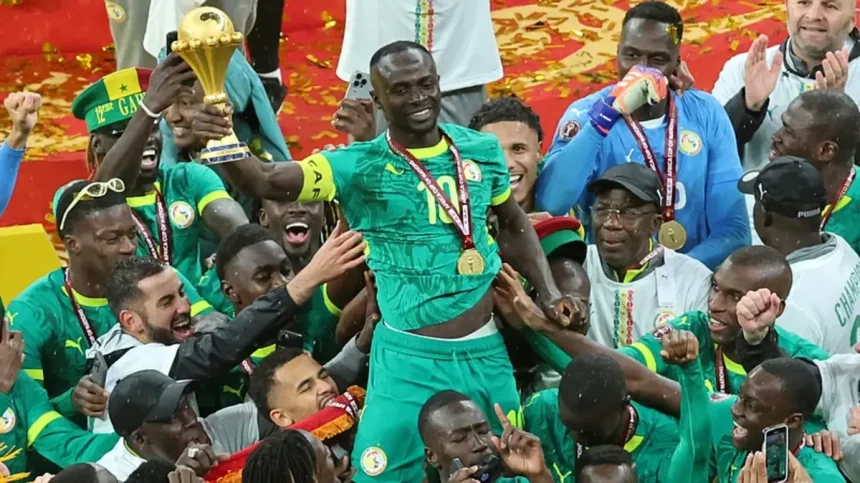
Senegal have been reinstated as champions of the 2025 Africa Cup of Nations (AFCON) after the Court of Arbitration for Sport (CAS) overturned the Confederation of African Football’s decision to strip them of the title and award Morocco a 3-0 victory.
The ruling, delivered on Tuesday, means Senegal retain the 1-0 victory they secured after extra time in the January final in Rabat, where Pape Gueye scored the decisive goal.
CAS ruled unanimously in favour of Senegal’s appeal, finding that the decision by referee Jean-Jacques Ndala to resume the match after Senegal’s players returned to the pitch fell within his authority.
The court said in a statement that the referee’s decision to restart or stop the match was within his sole authority.
“By blowing his whistle to restart play, the referee considered that the conditions for resuming the match had been met – both teams were on the pitch again, and both expressed their willingness to resume,” the statement said.
Senegal’s Football Federation (FSF) welcomed the ruling, describing it as a victory for sporting fairness.
“The FSF welcomes this ruling with deep satisfaction,” the federation said.
“This decision affirms, above all, the triumph of sporting fairness and reaffirms a fundamental principle: the true outcome of a match is determined exclusively on the field of play, under the protection of sports law.”
The Moroccan Football Federation (FRMF), however, expressed surprise at the decision and said it would pursue all available legal options to challenge the ruling.
How the AFCON title dispute started
Senegal defeated hosts Morocco 1-0 after extra time in a chaotic final at the Prince Moulay Abdellah Stadium in January to claim their second continental title.
The match was goalless deep into second-half stoppage time when referee Ndala disallowed what Senegal believed was a goal by Ismaila Sarr, having blown for a foul by Abdoulaye Seck on Achraf Hakimi.
The controversy intensified minutes later when Ndala awarded Morocco a penalty after a VAR review of a challenge involving El Hadji Malick Diouf and Brahim Diaz.
Senegal coach Pape Thiaw protested the decision and led some of his players and officials towards the dressing room. They later returned after more than 15 minutes, allowing the match to continue.
Diaz failed to convert the penalty, attempting a Panenka-style chip that was saved by goalkeeper Edouard Mendy.
The match went into extra time, where Gueye scored to give Senegal victory.
Morocco subsequently lodged a complaint with CAF, arguing that Senegal had breached Article 82 of the competition regulations by leaving the pitch without the referee’s permission.
In March, CAF’s appeals board ruled that Senegal had forfeited the final and awarded Morocco a 3-0 victory.
Senegal rejected the decision as “unfair, unprecedented and unacceptable” and appealed to CAS.
CAS rejects Morocco’s argument
In its appeal, Senegal’s federation argued that the referee’s decision to restart the match could not be reviewed under the established ‘field of play’ doctrine, which generally prevents sporting authorities from overturning decisions made by referees during a match unless there is evidence of arbitrary conduct or bad faith.
Morocco argued that the referee should have ended the match after Senegal’s players left the pitch and that the competition regulations on withdrawals should have applied.
ALSO READ: Morocco, Senegal await AFCON final verdict after court case
However, the CAS panel concluded that the referee’s decisions fell within his authority on the field and that the relevant Afcon regulations on withdrawals did not apply in the circumstances.
The panel acknowledged that Ndala had to make his decision in an atmosphere of extreme tension but said this did not make his judgment arbitrary.
The case was heard behind closed doors in Lausanne, Switzerland, on October 8 by a three-member panel led by French sports law expert Gerald Simon. Italian professor Luigi Fumagalli and University of Zurich professor Ulrich Haas completed the panel.
Morocco considers further legal action
Despite the ruling, the dispute may not be over, as Morocco’s federation has indicated that it intends to challenge the decision.
The FRMF had raised concerns about the arbitration process before the verdict was announced, alleging that Haas had a telephone conversation with FSF president Abdoulaye Fall on Sunday.
Fall denied that the call took place.
Morocco argued that any unauthorised communication between an arbitrator and a party involved in the case would constitute a breach of CAS regulations.
The federation could take the matter to the Swiss Federal Tribunal, which has limited powers to set aside CAS decisions on legal grounds.
Meanwhile, CAF president Patrice Motsepe has repeatedly said the continental governing body would respect and comply with the CAS ruling.
The dispute has also had wider implications for African football. Following Senegal’s walk-off during the final, the International Football Association Board introduced a rule allowing referees to send off players who leave the pitch in protest against a decision. The rule also applies to team officials who encourage such actions.
Senegal and Morocco have both qualified for the 2027 Africa Cup of Nations, but the controversy surrounding the previous final is likely to remain a talking point between the two football nations.