

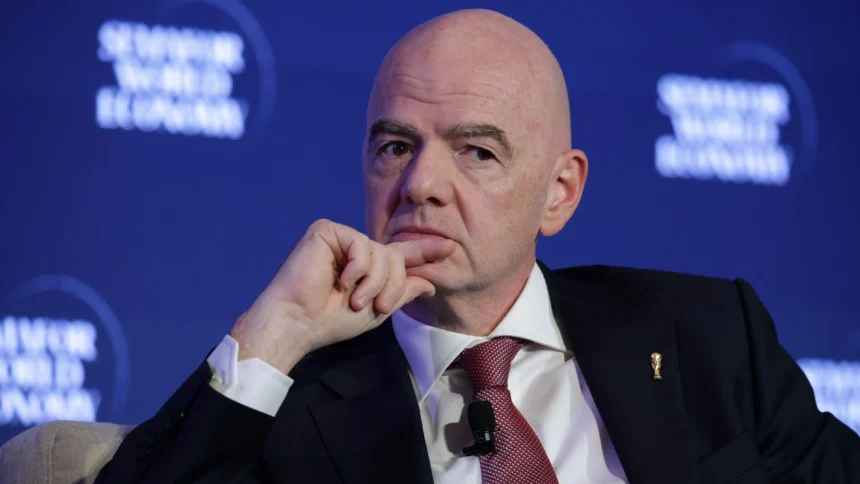
The Scottish Football Association (SFA) has withdrawn its support for Gianni Infantino and will not vote for his re-election as FIFA president, according to chief executive Ian Maxwell.
Infantino is facing growing opposition over his attempt, later abandoned, to create a new company to manage the commercial and ticketing rights of all FIFA competitions, including the World Cup, with 21% of the company proposed to be sold to a private investment company.
The proposed FIFA Forward Enterprise (FFE) was abandoned after widespread criticism from several confederations, led by UEFA, which has threatened a boycott of FIFA competitions.
“The position of the SFA has been clear since the 55 UEFA associations met,” Maxwell said while announcing Belgian Sebastian Pocognoli as Scotland’s new head coach.
“We have aligned ourselves with the UEFA position, and 55 nations are stronger than one voice.
“Their statement since then has talked about a lack of confidence in the FIFA leadership, and the Scottish FA agrees completely with that decision.
ALSO READ: ‘Crossed the line’, Ex-FIFA council member calls on Infantino to step down
“The SFA will not be voting for Gianni Infantino in the re-election in early 2027.”
Maxwell rejected suggestions that the SFA had previously failed to publicly state that it no longer supported Infantino because its president, Mike Mulraney, heads FIFA’s finance committee.
The football associations of England, Wales, and the Republic of Ireland have already declared that they have withdrawn support for Infantino, who is scheduled to seek a fourth term as FIFA president in March.
Growing opposition
Last week, FIFA and Infantino were accused of breaking trust “through deception” in an open letter issued by UEFA, CONCACAF, and the Asian Football Confederation.
The letter, signed by the presidents and general secretaries of the three regional governing bodies, said the controversy surrounding the FFE proposal was fundamentally about “the integrity of the game, and the integrity of those elected to lead it”.
While the statement did not name Infantino, sources told BBC Sport that it should be seen as an opportunity for him to resign and leave his position with dignity.
FIFA has committed to presenting a report on FFE to the next meeting of the FIFA Council, which is expected to take place in October.
The three confederations said this failed to “recognise that proper governance in the face of such a profound lack of judgement would require that such a review be conducted by a fully independent third party”.
The letter also underlined a legal warning made by UEFA that FIFA should not delete or destroy any documents related to the abandoned plans.
BBC Sport understands there have been preliminary discussions between the three confederations over breakaway competitions should Infantino remain in office. However, substantive talks are yet to begin, according to other sources.
There is currently no candidate who has declared an intention to stand against Infantino ahead of the 18 November deadline.
FIFA power struggle
The football world appears to have been divided by the dispute, with the confederations of Africa, South America and Oceania having backed Infantino.
However, there is disagreement within some confederations, making it difficult to predict whether Infantino or his opponents have the upper hand.
In Oceania, which has 11 member associations, New Zealand has said it will not follow the confederation’s position and will not vote for Infantino.
Mexico, Grenada, and St Kitts and Nevis have also broken ranks with the other 32 CONCACAF nations to support the FIFA president.
In Asia, eight of the confederation’s 46 members have so far backed Infantino: the United Arab Emirates, Qatar, Sri Lanka, Lebanon, Kuwait, Mongolia, the Philippines and Bhutan.
The FIFA Council, which consists of 36 confederation and national association heads plus Infantino, also appears divided.
The dispute has raised questions about whether Infantino has the political authority to govern FIFA effectively, even if he wins the election involving all 211 member associations.
The first test of UEFA’s threat could come in September, when the FIFA Under-20 Women’s World Cup is scheduled to begin in Poland, and the tournament features five other European nations, including England.
(BBC)


